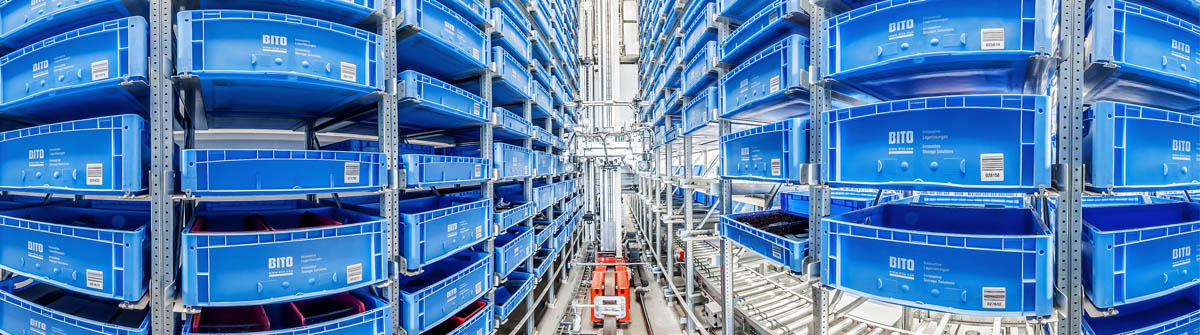


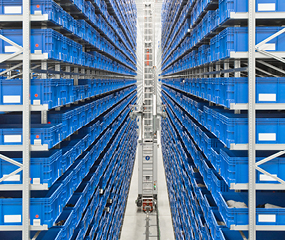
An automated small parts warehouse handles the storage and retrieval of containers, cartons or trays. Warehouse management software controls stock levels and transmits orders to the system controller. During storage, the conveyor system transports the load carrier to the designated handover position in the storage aisle. A storage and retrieval machine or shuttle takes over and stores it in the racking system. For retrieval, the system automatically retrieves the required item. The conveyor system then transports the container to the picking station.
The goods-to-person principle reduces manual movement and ensures a predictable flow of materials. The specific implementation depends on the system chosen. For high access rates and short lead times, for example, shuttle systems or autonomous warehouse robots may be suitable.
Drawing or gripping technology, Combination telescopic forks
Totes, Bins, Cardboard Boxes, Trays
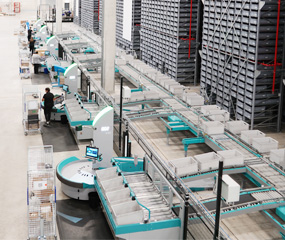
An automated small parts warehouse is particularly worthwhile when large numbers of small parts need to be stored in a limited space and frequently retrieved. High access rates, short retrieval times and increasing quality requirements for order picking all indicate that automation is the right choice. However, it is not simply the number of items that is decisive.
Other factors influencing the choice include stock levels, turnover, throughput, container sizes, available floor space and the desired process capacity. A distinction is also made between a warehouse integrated into an existing building and a silo warehouse, where the building structure is carried by the steel racking. Labour costs also play a role. If staff have to cover long distances during manual order picking, the potential for savings with an automated system is significant, as goods are delivered directly to the workstation. When making an investment decision, companies should therefore consider both current material flow and expected growth. A well-planned system creates capacity reserves without making the facility unnecessarily large.
AKF, Bestseller, Brütsch Rüegger, Dräxlmaier, Göpfert, Hauff, Imperial, Kuehne+Nagel, Marburger, Mosca, Perschmann, Riegler, Simba Dickie, TTI, Winkler
Deep-freeze warehouse: Früchte Jork, Kofler, Walther Frischdienst
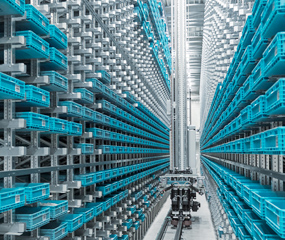
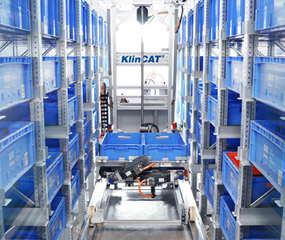
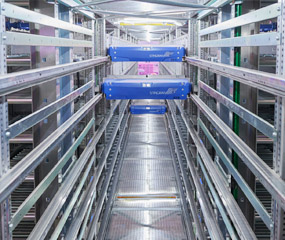
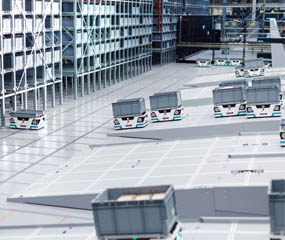
Stacker cranes, shuttle systems and autonomous warehouse robots differ in terms of throughput, storage density, flexibility and scalability.
The most suitable solution therefore depends on factors such as product structure, access frequency, throughput, stock levels and available space. A material flow analysis provides the basis for making this selection.
Klinkhammer - Consulting also for the following topics:
Full service for your challenge in the small-parts warehouse
We at Klinkhammer look back with pride on more than 50 years of experience with storage systems of all kind. This high expertise is our greatest strength which we are happy to apply for your tasks. We will provide you with tailor-made, customized all-round packages which leave nothing to be desired. Call us, we will be glad to advise you.

Energy can be saved in the stacker crane used in an automated small parts warehouse or high-bay pallet warehouse through the use of Super Caps. The braking energy generated by the stacker crane is fed directly back into the system. SuperCaps act as the energy storage medium. This sustainable technology enables the operator to save up to 40 per cent in energy, as the energy requirements of the stacker cranes are significantly reduced. Power peaks in the supply network can be absorbed and mitigated by the energy storage systems. As a result, infrastructure such as cables, UPS units, transformers and fuses can be designed to be smaller, thereby offering potential for further savings.
An automated container storage system increases storage density and reduces the distances involved in order fulfilment. The specific benefits depend on the system’s design and the requirements of the business.
A small-parts warehouse therefore does more than just improve storage. It integrates stock management, t3://page?uid=124conveyor technology and order picking into a seamless process.
An automated small-parts warehouse only achieves its full potential through the interplay of warehouse technology, conveyor systems and software. The individual components must be coordinated so that put-away, retrieval and order picking can take place without unnecessary waiting times. The KlinkWARE warehouse management system manages stock levels and storage locations. The system control unit implements the orders technically and coordinates storage and retrieval machines, shuttle systems and conveyor technology. For order picking, the software determines which container is to be made available and when. This creates a seamless flow of goods between the warehouse, the staging area and downstream processes. When planning, therefore, consideration should be given not only to the warehouse system but to the entire process chain. Interfaces with existing IT systems and plant equipment also play an important role.
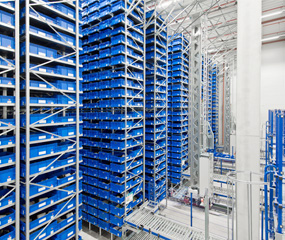
An automated small parts warehouse is suitable for companies that store and regularly dispatch a wide variety of items within a limited space. Typical areas of application include manufacturing, the food retail sector, e-commerce, and spare parts and distribution logistics. In manufacturing, for example, an automated small parts warehouse supplies assembly or production areas. In distribution, it facilitates rapid order picking and prepares items for dispatch accurately and reliably.
The cost of an automated small-parts warehouse depends heavily on factors such as storage and retrieval capacity, the number of bin or tray storage locations, the number of aisles, storage technology (stacker cranes, shuttles or autonomous mobile robots), whether the system is built-in or a silo warehouse, the number and design of picking stations, and integration with production and dispatch. In addition, automatic carton erector machines, carton sealers, the automated application of dispatch labels or fully automated order picking using piece-picking robots can increase the investment costs. Solutions for automated small-parts warehouses using stacker cranes as integrated storage systems within an existing hall often range from €1.5 million to €5 million, whilst high-performance systems with shuttles or autonomous mobile robots frequently start at €3 million and, depending on size and configuration, can incur investment costs of over €10 million.
An automated small-parts warehouse should not merely meet current requirements. Rising order volumes, additional items or changes to processes can increase demands on capacity and throughput. When planning, expansion options should therefore be taken into account from the outset. Depending on the system, additional storage locations, containers, shuttle vehicles, warehouse robots or further picking stations can be integrated. The software must also be able to scale up. New storage areas and changed processes require suitable interfaces and flexible control systems. For existing systems, retrofitting is also an option. Modernised control systems, software or individual components extend the service life and bring the system up to the latest technical standards.
Klinkhammer does not design automated small-parts warehouses according to a fixed standard system, but rather on the basis of the specific material flow. As a manufacturer-neutral system integrator, the company combines suitable warehousing technology, conveyor technology, control systems and software. Klinkhammer supports the entire project, from logistics planning and material flow control through to project planning, commissioning and Service24. In-house software solutions support warehouse management and system control. Existing systems can also be further developed. Through retrofitting and modernisation, companies can adapt existing technology to new performance requirements without having to replace the entire system.


Cookie Settings
![[Translate to English:] AKL mehrgassig](/fileadmin/user_upload/Bilder_Header-1200px/Klinkhammer_Kleinteilelager-Header.jpg "[Translate to English:] Automatisches Kleinteilelager")