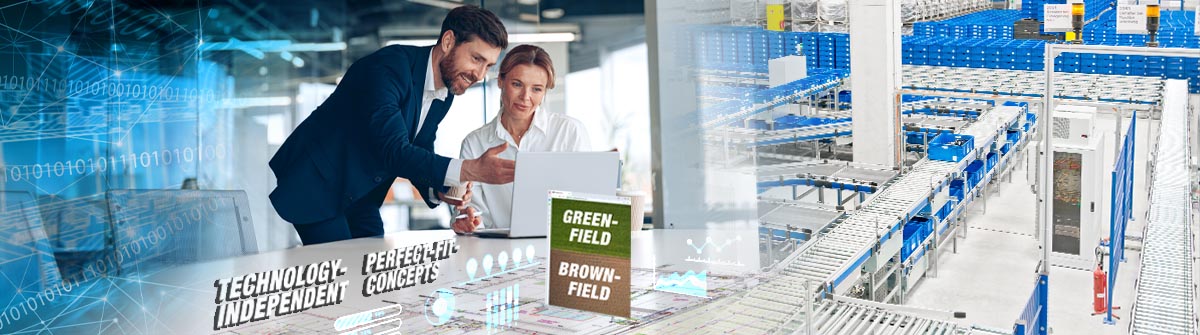

Warehouse planning refers to the systematic planning and design of a warehouse. The aim is to organise the required capacity, the appropriate technology and the processes in such a way that goods can be stored and moved efficiently, quickly and cost-effectively. When planning logistics, it is also important to consider the possibility of automation. In these warehouses, storage, order-picking and internal transport processes are supported by technical systems such as automated storage and retrieval machines, shuttles, robots and conveyor systems.
In warehouse planning, the company’s requirements are first analysed and objectives set. These include the number and sizes of items, storage capacity, daily stock-in and stock-out operations, spatial conditions and the desired delivery speed. Subsequently, the future processes, warehouse technology, material flows, structural requirements, warehouse layout and IT systems are planned. In addition, the investment costs and future operating costs are assessed. Warehouse planning is based on a logistics concept, which Klinkhammer divides into four phases.
The result of the status analysis is a detailed picture of the current material flow, which serves to highlight bottlenecks in future projections and identify potential for improvement. Building on the current data, future throughput requirements are projected based on growth scenarios. From this, a target material flow is developed across the processes under consideration and for various scenarios.
Automation is particularly beneficial when large volumes of goods need to be moved and high throughput rates are required. Companies with a high volume of daily orders can use automated systems to speed up their processes, whilst reducing errors and saving space. Even in the face of rising labour costs or a shortage of skilled workers, automation can offer economic benefits as well as significantly improve working conditions, for example in deep-freeze warehouses. This can be verified through forward-looking warehouse planning.
The purpose of a variant comparison is to develop an optimal, cost-effective and future-proof solution, independent of any specific manufacturer. During the preliminary design phase of warehouse planning, manual, partially automated and fully automated options are usually compared. In addition to cost-effectiveness, criteria include performance, error rates, space requirements, clearance heights, scalability and expandability, ergonomics and reliability, as well as structural, climate control and fire safety aspects.
Automation is often not worthwhile when only small quantities of goods are stored or moved. Furthermore, where product and order structures fluctuate significantly, the investment costs in conventional, specialised automation technologies may not be economically justifiable. In such cases, manual or semi-automated warehouse concepts are often more flexible and cost-effective. In future, highly flexible technologies such as autonomous warehouse robots or humanoid robots will also need to be weighed up against manual approaches, provided the necessary level of technical maturity has been achieved.
The main aim of warehouse planning is to achieve the optimal balance between performance, flexibility and costs. By selecting the right warehouse technology, capacity and processes, the aim is to ensure that the warehouse efficiently meets the company’s current and future requirements, such as growth and delivery capacity.
Klinkhammer specialises in holistic warehouse planning, whether for greenfield or brownfield projects. With decades of experience, Klinkhammer develops tailor-made solutions that are precisely tailored to the requirements of industry, the food retail sector and e-commerce – from goods-in to storage and order picking through to dispatch.
Klinkhammer particularly distinguishes itself through manufacturer-independent consultancy, innovative technologies, in-depth process analyses and comparisons of different options. Through access to a wide range of warehouse systems and the use of modern planning tools, material flows are analysed, bottlenecks are identified at an early stage and potential investments are assessed from an economic perspective. Whether it is a manual warehouse or a partially or fully automated logistics centre: customer benefit is always at the heart of warehouse planning. As a systems integrator, experience gained from commissioning is also incorporated into the planning at an early stage, thereby shortening implementation times. Klinkhammer helps its customers to make their logistics operations more competitive, more cost-effective and more efficient in the long term.


Cookie Settings